
What we crop out.
A highlight from the most packed week ever

There are some weeks when it feels like everything sucks and life will never be any different than it is now. On a personal level, I deal with a (relatively newly diagnosed) autoimmune chronic illness, which pretty heavily affects my energy levels and diet options — which then affects my social life, usually for the worse. Being out of the house on my feet for multiple days in a row is always me taking a gamble on if/ how badly I will have an “AI Hangover”, as we call it. (God forbid if I’m not wearing my HOKAS!) Plus, the impossibly high cost of living in this area tied with a shitty economy makes it impossible to feel like anything I do is moving me forward to a tangible, stable future, and everything is expensive so I should stay home. The nihilist depression wins. Why do anything?
But some weeks, my meds are working and I’m feeling pretty good. Some weeks, I have the opportunity to do cool things and I push myself to go and do it. (And I can convince myself I’m okay with a bit more credit card debt in the name of A Good Time.)
Last week was one of the good weeks. I was extremely fortunate to be able to see three (!!!) very cool, very different pieces of theatre, thanks to the generosity of some friends and connections. I figured this was a great, serendipitous chance to test out my new Substack space with a legitimate, juicy post. I chose the most impactful of the plays I saw to write about more deeply — I may explore my thoughts on the others in the future, still figuring this thing out and all that. There are mild spoilers ahead for the production in New York. Thank you for reading!
Here There Are Blueberries by Moisés Kaufman + Amanda Gronich
April 30th, 2024
Over the course of March and April, I participated in New York Theatre Workshop’s Casebook program. I have always been a fan of the work coming out of the Workshop (and am seriously dying for them to un-”indefinitely postpone” the 2020 adaptation of Three Sisters that was supposed to star Greta Gerwig and Oscar Issac with Sam Gold directing). They are currently co-producing the New York premiere of Here There Are Blueberries alongside Tectonic Theater Project.
Casebook is a program that provides participants “unprecedented access to the artists involved in the creation of a new work from rehearsal to production.” I am so often working at early points in the process with playwrights that I don’t often get to see the “fruits” of the labor continue— I was finding myself wanting some creative inspiration. Being up close for this process seemed like a low-stakes way to do that. I’ve also been following this play for some time; I was an education intern with Tectonic Theater Project back in 2018 when they were just starting to do workshops of the piece, then titled The Album— which then evolved into The Album: Here There are Blueberries, which was then shortened to its current title… but I still often call it The Album out of a weird habit. I got the marketing email about the class right before my birthday, figured I could write off the tuition charge as part of my “small business” in a total fuck-it-we-ball move, and signed up. For seven weeks— two of which I was too AI Hungover for, but such is life— I got to hear from the creators of the show just exactly how the seven-year-long process of making this show was coalescing here in New York City.
The premise of the play is simply written:
Based on real events, Here There Are Blueberries tells the story of an album of historical Nazi-era photographs—what they reveal about the perpetrators of the Holocaust, and our own humanity.
The story we witness in the theater is that of the Höcker album, containing the aforementioned historical photographs of Nazis at Auschwitz, circa 1944-45. The deeper dramaturgy of this play is fascinating - it’s not a verbatim theatre piece per se, but it is a piece of documentary theatre. It’s a devised piece designed to marry fact with dramatic license. Text was sourced from transcripts, primary source documents, and interviews with real people such as museum staff, family members, and other folks adjacent to the album’s contents. Photos, naturally, were taken from the actual album, and turned into projections: the crown jewel and lifeblood of this production. Practical and cued sound, lights, architecture, and costumes fleshed out a story of “complicity, complacency, and culpability”, where actors stepped into numerous, multiple parts. Most of the play is directed right to the audience, leaving us feeling just as involved in the story as if we were museum staff workers ourselves. At the very least, we are active witnesses to the story.
Through the guidance of Rebecca Erbelding, Holocaust historian and archivist, the play follows the sharing of the Höcker album from its anonymous donor, its delivery and donation to the United States Holocaust Memorial Museum, and the ensuing mystery of unraveling the story of the album: who took these pictures? who, what, and where was captured in these pages? what do we do with it? why is this here? and, ultimately, what now? The play explores the historical significance of these photos emerging, such as the fact that photos from the album definitively place Josef Mengele at Auschwitz for the first time ever; the play also explores the deeper, more nuanced emotions of what it means to have the historical record now permanently changed— and what it is like being the person to shepherd that history into the public consciousness.
“It’s very powerful to be able to see what we’re not supposed to see. And we were not supposed to see this.
The idea that this album would wind up at this memorial museum...it would have been the worst thing in the world for the Nazis to imagine.
Which is why I think Karl Höcker must have lost track of it. Because he should have destroyed it.
It should have been destroyed. And I can’t explain why it wasn’t.”
Rebecca Erbelding in Here There Are Blueberries, Kaufman and Gronich (2023)
As a student of Moment Work, Tectonic’s devising method, I was back in my element. I had the privilege of learning it from Barbara Pitts McAdams and Scott Barrow during my senior year of undergrad, which culminated in my capstone class making a full-length, fully produced play. Most plays you will see were made by a single playwright writing a script full of words, which was then handed off to collaborators to visually interpret. Moment Work, at its simplest, asks an artist to engage with how non-textual elements can carry narrative - and begs us to create work in a room together, fully exploring these elements and how they can build a play. With Moment Work, a play starts by looking at an idea or a question, and then making units of theatrical storytelling with non-text elements (lighting, clothing, sounds, found objects). It’s hard to describe it without doing it, but it can be really life-changing for an artist to make work this way… it certainly was for me.
To give an example, in a regular playmaking process, a writer could say “The image is projected onstage and the Archivists will say such and such line.” Designers, actors, and director will make choices about how to stage and make that happen. In a Moment Work process, someone might say, “I want the audience to be immersed in this image, and to feel how normal it is to eat blueberries despite their context of being in Auschwitz. What if we illustrated what the sound of this photo may have been like while it’s being projected?” And that’s how you get cast members creating a soundscape of bowl-and-spoon-scraping, giggling, and concertina music while the audience takes in the projection of the photo below. (That’s a true moment in the play, which I found particularly evocative and grounding.)
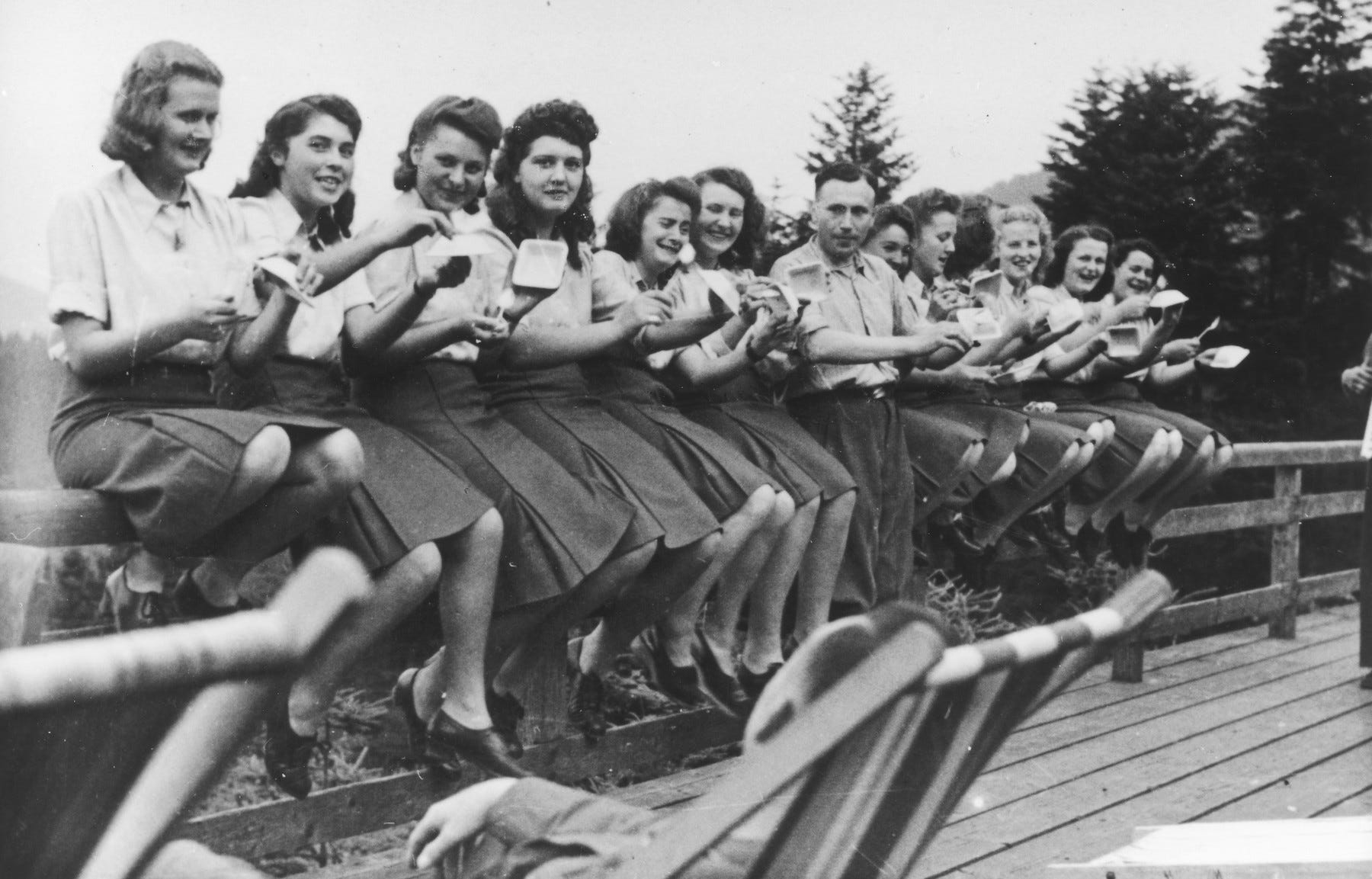
Image: “Members of the SS Helferinnen (female auxiliaries) and SS officer Karl Hoecker invert their empty bowls to show they have eaten all their blueberries.” United States Holocaust Memorial Museum, courtesy of Anonymous Donor. 1944.
While there was a robust use of text used to engage the audience in the story, if you took all of the words away and made some tweaks to staging, you could have still understood what was happening and what the artists were trying to convey. The story would stand. What a unique way to experience theatre! Personally, I think that this play exists in the very effective way that it does only because it was born of devising.
I think the strongest choice in this work was framing the story of a monumental album by looking at the medium of photography itself first. As the lights go down and we see performers for the first time, we are introduced to a little Leica camera that’s been on display while the house fills up. Two actors speak of the role of hobby photography in German society post-World War I, where seemingly anyone could own and snap photos on a snazzy little camera! (Photography had developed into the preeminent way to document things during the war, and was much more accessible now than it had been in the late 19th/early 20th century.) Projected photos accompanying this prologue quickly progressed from scenes of idyllic leisure to casual displays signifying the arrival of open fascism. The fully revealed ensemble of actors all transform into archivists for the next 90 minutes, guiding us through the intimate examination of the photos and their implications. We are left wondering what, in the end, has been left behind.
“This album could have easily been left for some other historian to ‘discover’ someday...or maybe never. It’s inevitable. Things will get lost on our watch.
It keeps me awake at night: how the gathering of knowledge can be so precarious.
…
But I can’t help wondering what I – what all historians...what each of us – have left behind in boxes.“
Rebecca Erbelding in Here There Are Blueberries, Kaufman and Gronich (2023)
Blueberries is certainly one of my soul plays - soul play, yes, a term I have just made up. Watching that production just made me… buzz. No better way to say it. I could feel myself sitting there like, “Yes. YES. YES. This is what I want to make. This is what I want to see. This is what I do all of this for: trying to make something like this exist!!” It was so informative, emotionally moving, and theatrically engaging. It was the finest balance of pathos and logos I have seen in a work in a long time.
I left Blueberries feeling true catharsis… or perhaps just emotionally drained. Resolved, as a witness to history past and history being made in the present.
I feel it important to share that my husband works for an online Jewish news organization, and we have created a home centering left, Jewish values. The nature of his work and, by extension, his identity inform the place from which we see, consume, and interpret “Holocaust media”. It’s a particularly moving experience for me to see this play, while my husband specifically uses photos to share stories about the Shoah, Jewish life, Jewish stories — which garners him and his colleagues regular online harassment from Neo-Nazis. He works from home, and there’s little separation from identity and work for him. I say all this to say that I am, perhaps, a primed audience for a play such as this. We regularly discuss the type of content and themes in this play because it is a part of our daily life.
This piece may engage with historical content, but it proves that history never ceases to be relevant. It is alive. This play was a reminder that genocide started with words, which then evolved into actions, captured in pictures that no one wanted you to see, let alone see 80 years later in a play written by Jewish people while sitting next to a Jewish man you’re married to. I cannot help but think of our current world, where we have platforms and technology that simply did not exist then. Even while we are at the mercy of algorithms created by corporate billionaires with opaque agendas, it is almost impossible to ignore what is happening “outside the frame” as witnesses of photos, videos… but is that what happened with Germans then, truly? The Zone of Interest (2023) and many other points prove otherwise.
I have always believed so, but this play reminds us that it is so essential that we document everything. I think of this now in regards to the ongoing genocide in Gaza; how information has been used, flowing, distributed, tailored— how there is a war of content happening too. I think of how almost everyone has a camera on their phone that they carry with them now, the technology even more sophisticated and accessible than it was to the Germans in this play. One would hope we know to be more vigilant in recognizing and stopping atrocities, now that many have documentary tools and platforms to engage with right in our pockets. We cannot allow other Höcker albums to exist, and I feel that thanks to our online generations, we will not allow any cropping to happen unchallenged and without a fight.
How are we, each of us, complicit, complacent, and culpable at this very moment? How can we move forward?
While in the process of writing this Substack post, Here There Are Blueberries was named a Finalist for the 2024 Pulitzer Prize in Drama. Do not miss the chance to experience this piece if you can - for my Northeast readers, it will be playing at NYTW through June 16th, and at McCarter Theatre Center in Princeton from January-February 2025.